



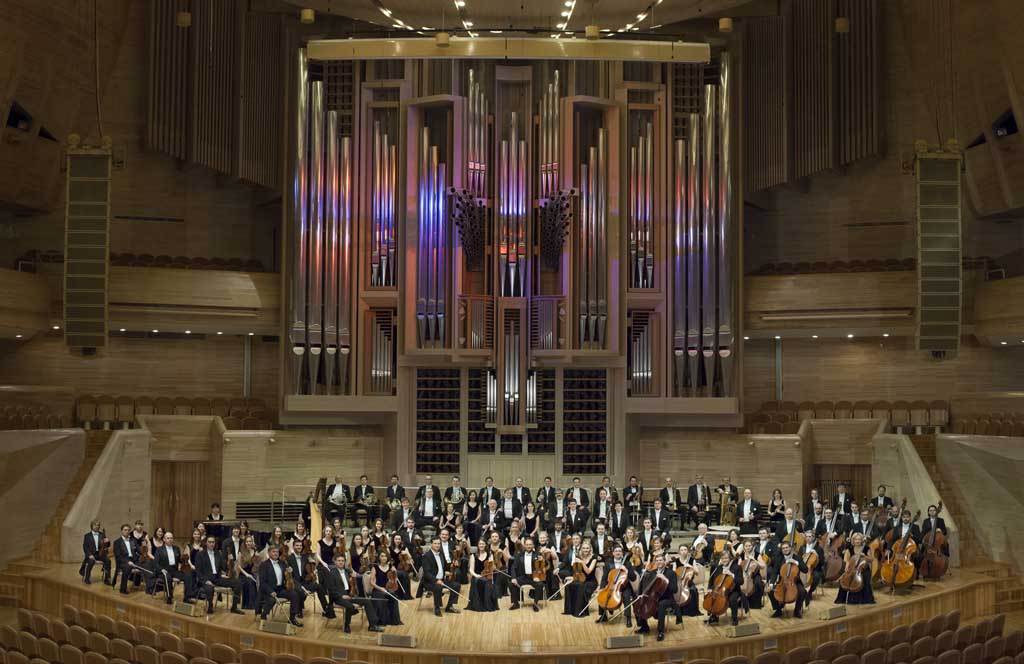
“Russian Philharmonic” Reborn: From TV-6 Orchestra to Luzhkov’s Ensemble

Elena CHEREMNYKH, Kommersant, 21 March 200
Recently, the Moscow Culture Committee established and placed on the city hall’s payroll the former TV-6 orchestra, “Russian Philharmonic”, under the direction of Alexander Vedernikov. With an inaugural concert in the Great Hall of the Conservatory, the “Luzhkov” ensemble accounted for its professional competence.
Having operated for three years (1995–1998) under the auspices of its first founder—the TV-6 television channel—the “Russian Philharmonic” was disbanded in August 1998. Left in its wake were a few musical broadcasts, a compact disc featuring Dunayevsky’s music, and a sold-out premiere of Krzysztof Penderecki’s 13-minute opus Gloria Tibi Domine / Slava svyatomu Daniilu — knyazyu moskovskomu in the Great Hall of the Conservatory. The fact that, a year and a half later, the orchestra was re-assembled by the very same conductor—Alexander Vedernikov Jr.—commands profound respect. Forty musicians from the original line-up joined the new ensemble. Their youth, zeal, and unreserved devotion to their 38-year-old leader and artistic director can already be interpreted as a winning platform for Moscow’s youngest symphonic orchestra.
The programme for the reborn Philharmonic’s debut proved more than ambitious. The first half comprised Wagner—the Overture and Bacchanale from Tannhäuser, the Prelude to Act III of Lohengrin, and the Overture to Die Meistersinger von Nürnberg, alongside two vocal numbers featuring American tenor Ronald Hamilton. The second half featured Scriabin’s Prometheus (with piano solo by Sergei Erokhin, Spain). Much of what was successfully conveyed—even in comparison with such advanced collectives as the Russian National Orchestra and the State Academic Symphony Orchestra—was profoundly encouraging. Articulatory discipline, a fresh sound, complete mutuality with the conductor, and exquisitely crafted solos from the principal violin, clarinet, horns, and trumpet.
At the press conference preceding the concert, Alexander Vedernikov did not conceal that in developing the strategy for the “Russian Philharmonic”, he factored in both genuine competition with other orchestras and the challenges of musician recruitment. Out of the one hundred players at his disposal, the conductor spoke warmly of the wind section (expressing particular pride in the horn quartet) and lamented a shortage of violins. Regrettably, during the performance of Wagner, this very circumstance tipped the balance in favour of the brass—albeit a first-rate and exceptionally diligent one. In the absence of string depth, the performance maintained its equilibrium through noble climaxes and impeccably polished ensemble passages.
Of the two guest soloists partnering the "Russian Philharmonic", the more fitting was the flexible and stylistically perceptive Sergei Erokhin, an émigré Musician and pupil of Dmitry Bashkirov’s piano class. Supplemented by Andrey Kozhevnikov’s choir and the organ (Lyudmila Golub), Prometheus produced a remarkable effect. So adroitly did Vedernikov rationalize the triple alliance of piano, choir, and orchestra; so intelligently did he avoid the usual extremes of performance—both radiant pomposity and salon symbolism. The son of the celebrated bass Alexander Vedernikov has proven himself an exceptional conductor. The Moscow City Hall has made a fine acquisition.
Source.
Having operated for three years (1995–1998) under the auspices of its first founder—the TV-6 television channel—the “Russian Philharmonic” was disbanded in August 1998. Left in its wake were a few musical broadcasts, a compact disc featuring Dunayevsky’s music, and a sold-out premiere of Krzysztof Penderecki’s 13-minute opus Gloria Tibi Domine / Slava svyatomu Daniilu — knyazyu moskovskomu in the Great Hall of the Conservatory. The fact that, a year and a half later, the orchestra was re-assembled by the very same conductor—Alexander Vedernikov Jr.—commands profound respect. Forty musicians from the original line-up joined the new ensemble. Their youth, zeal, and unreserved devotion to their 38-year-old leader and artistic director can already be interpreted as a winning platform for Moscow’s youngest symphonic orchestra.
The programme for the reborn Philharmonic’s debut proved more than ambitious. The first half comprised Wagner—the Overture and Bacchanale from Tannhäuser, the Prelude to Act III of Lohengrin, and the Overture to Die Meistersinger von Nürnberg, alongside two vocal numbers featuring American tenor Ronald Hamilton. The second half featured Scriabin’s Prometheus (with piano solo by Sergei Erokhin, Spain). Much of what was successfully conveyed—even in comparison with such advanced collectives as the Russian National Orchestra and the State Academic Symphony Orchestra—was profoundly encouraging. Articulatory discipline, a fresh sound, complete mutuality with the conductor, and exquisitely crafted solos from the principal violin, clarinet, horns, and trumpet.
At the press conference preceding the concert, Alexander Vedernikov did not conceal that in developing the strategy for the “Russian Philharmonic”, he factored in both genuine competition with other orchestras and the challenges of musician recruitment. Out of the one hundred players at his disposal, the conductor spoke warmly of the wind section (expressing particular pride in the horn quartet) and lamented a shortage of violins. Regrettably, during the performance of Wagner, this very circumstance tipped the balance in favour of the brass—albeit a first-rate and exceptionally diligent one. In the absence of string depth, the performance maintained its equilibrium through noble climaxes and impeccably polished ensemble passages.
Of the two guest soloists partnering the "Russian Philharmonic", the more fitting was the flexible and stylistically perceptive Sergei Erokhin, an émigré Musician and pupil of Dmitry Bashkirov’s piano class. Supplemented by Andrey Kozhevnikov’s choir and the organ (Lyudmila Golub), Prometheus produced a remarkable effect. So adroitly did Vedernikov rationalize the triple alliance of piano, choir, and orchestra; so intelligently did he avoid the usual extremes of performance—both radiant pomposity and salon symbolism. The son of the celebrated bass Alexander Vedernikov has proven himself an exceptional conductor. The Moscow City Hall has made a fine acquisition.
Source.